
Euphoria Shows the Overdose — But Not What Actually Saves Lives
Last updated: April 2026
Euphoria Season 3 is finally here, and once again, HBO’s most visceral drama is forcing millions of viewers to sit with the reality of substance use in America. The fentanyl storyline hits harder this time — partly because creator Sam Levinson has said publicly that he was “really angry about fentanyl” after the real-life death of cast member Angus Cloud in 2023. In the year Angus died, over 73,000 Americans died from fentanyl overdoses alone.
 But here’s the thing that keeps getting missed — on the show and in our culture at large. Euphoria dramatizes the overdose. It captures the terror, the chaos, the aftermath. What it consistently fails to do is show the audience what actually reverses one. Back in Season 1, Rue’s overdose was central to the plot. Her younger sister Gia found her unconscious, covered in vomit. The show never explained how she was revived. Later, when Rue collapsed after taking fentanyl at Fez’s place, Narcan was mentioned in passing — but the scene focused on the panic, not the science. And that’s a missed opportunity with real consequences.
If you’re a millennial or Gen Z viewer in the United States right now, overdose is the leading cause of death for people your age — Americans between 18 and 44. Not car accidents. Not gun violence. Overdose. And the single most effective tool we have to reverse an opioid overdose in real time costs less than a decent pair of headphones. It’s called Narcan, and almost nobody you know is carrying it.
What Is Narcan and How Does It Work?
Narcan is the brand name for naloxone, a medication classified as an opioid antagonist. In plain terms, it binds to the same receptors in your brain that opioids like fentanyl, heroin, and prescription painkillers attach to — and it blocks them. When someone is overdosing on opioids, their breathing slows to dangerous levels or stops entirely. Naloxone essentially kicks the opioid molecules off those receptors, restoring normal breathing within two to five minutes.
It comes as a nasal spray — no needles, no medical training required. You spray it into one nostril, lay the person on their side, and call 911. That’s it. The FDA approved Narcan for over-the-counter sale in March 2023, and it became available in pharmacies nationwide by September of that year. You don’t need a prescription. You don’t need to explain why you want it. You just buy it.
And here’s what makes naloxone remarkable from a clinical standpoint: it only works on opioids. If someone hasn’t taken an opioid, naloxone does nothing. It has no potential for misuse. It doesn’t get anyone high. It is, in the most literal sense, a medication that does one thing — stop people from dying.
The Numbers That Should Change Your Mind
Let’s talk about what’s actually happening in this country, because the statistics paint a picture that’s impossible to dismiss as “someone else’s problem.”
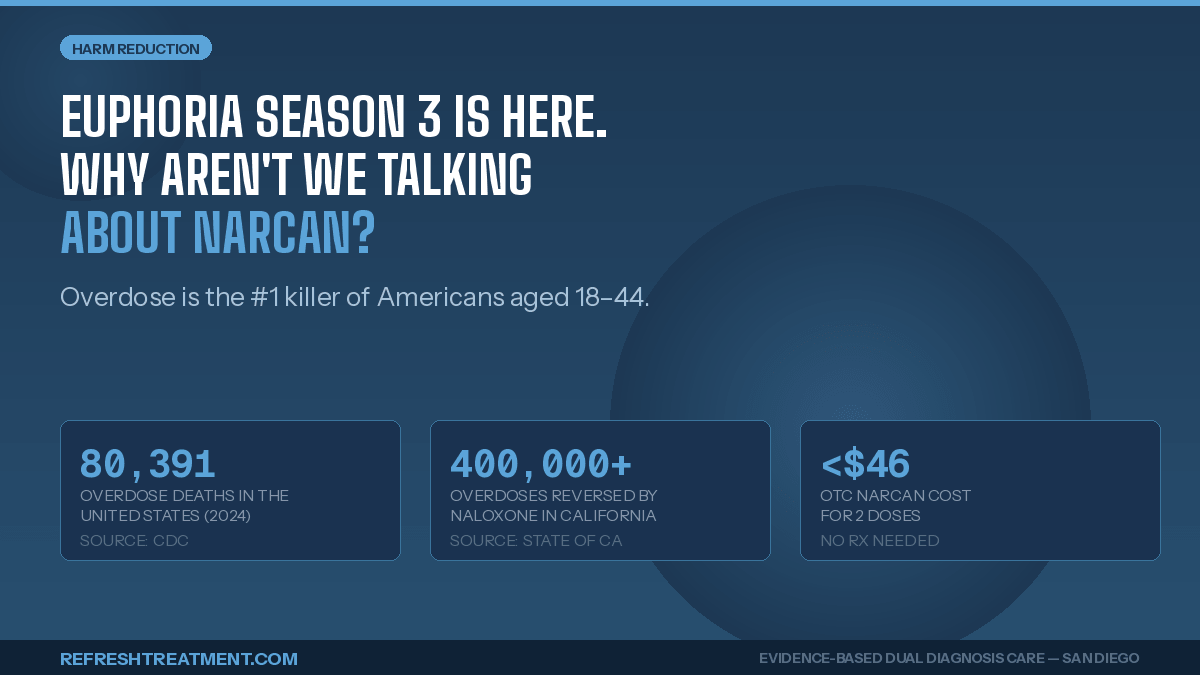
According to the CDC, there were an estimated 80,391 drug overdose deaths in the United States in 2024 — a significant decrease from 110,037 in 2023, but still a staggering number. Preliminary data for the 12 months ending October 2025 projects approximately 71,542 deaths. The trend is improving, and researchers credit expanded naloxone distribution as a key driver of that decline.
But context matters. Fentanyl was involved in more than 48,000 of those deaths in 2024. It’s 50 times more potent than heroin and 100 times more potent than morphine. A lethal dose fits on the tip of a pencil. And it’s being pressed into counterfeit pills that look exactly like Xanax, Percocet, and Adderall — pills that end up at parties, on college campuses, and in the medicine cabinets of people who never intended to take an opioid at all.
The people dying aren’t a monolith. They’re college students. Coworkers dealing with chronic pain. Friends experimenting on a weekend. Siblings self-medicating anxiety or depression they haven’t been able to get help for. Overdose doesn’t discriminate by income, education, or zip code. It discriminates by whether someone nearby had naloxone when it mattered.
The “It Won’t Happen to My Kid” Problem
If you’ve ever thought about buying Narcan and then didn’t, you’re not alone. Surveys and behavioral research consistently show that people recognize naloxone saves lives — and then don’t purchase it anyway. The most common reason? The belief that overdose is something that happens to other people. Other families. Other neighborhoods.
This is the same cognitive bias that makes people skip flood insurance in a floodplain. We’re wired to underestimate risks that feel emotionally distant, even when the data says otherwise.
Consider: the opioid dispensing rate in the U.S. is 39.5 prescriptions per 100 people. The naloxone dispensing rate? Just 0.5 per 100. For every 79 opioid prescriptions written, one naloxone kit gets dispensed. That math doesn’t make sense in a country where the majority of overdose deaths involve opioids.
And the “it won’t happen here” mentality ignores a critical reality — you don’t have to use opioids yourself to encounter an overdose. It could be a roommate. A coworker in the bathroom at a restaurant. A stranger on the subway. A friend who took what they thought was a Xanax at a concert. The person who needs Narcan might be someone you’d never suspect, and the two to five minutes it takes for naloxone to work could be the difference between a close call and a funeral.
Why Does a $46 Nasal Spray Feel So Controversial?
A two-dose pack of OTC Narcan retails for about $45.99 at most pharmacies. In California, the CalRx program has driven the cost down to approximately $22.50 — less than what most people spend on a single DoorDash order. Yet naloxone remains one of the least prioritized items in American households, well behind first-aid kits, fire extinguishers, and EpiPens.
Part of the problem is cost perception relative to perceived risk (see above: “it won’t happen to me”). But there’s a deeper issue at play — one rooted in stigma, moral judgment, and a fundamental misunderstanding of how substance use disorders actually work.
The Stigma and Shame That’s Still Killing People
Here’s where we need to be honest about what’s really going on. In 2026, in a country that has watched overdose become the number one killer of young adults, there are still people — lawmakers, parents, community leaders — who view naloxone with suspicion. The objections tend to follow predictable patterns:
“It’s enabling.” This is the most persistent myth. The argument goes that if people know naloxone exists, they’ll use drugs more recklessly — that having a safety net encourages risky behavior. Researchers call this the “moral hazard” hypothesis. And the evidence thoroughly dismantles it.
A systematic review published in the International Journal of Drug Policy found no evidence that take-home naloxone provision was associated with increased opioid use or overdose. A study from Ohio State University found that increased naloxone access didn’t lead Americans — including people who use drugs — to perceive heroin as less risky. Research in Drug and Alcohol Dependence found that people with higher levels of naloxone protection actually reported fewer opioid-related risk behaviors, not more. And a multi-state analysis found no increase in adolescent heroin use or injection drug use in states that passed naloxone access laws.
The “enabling” argument isn’t supported by a single credible study. Not one.
Understanding Overdose Prevention
“Narcan is basically a drug itself.” This misunderstanding comes from people conflating naloxone with medications used in medication-assisted treatment, like buprenorphine or methadone. Naloxone has zero psychoactive effects. It doesn’t produce euphoria. It can’t be misused. Calling naloxone a drug in any recreational sense is like calling an EpiPen a stimulant because it contains epinephrine.
“They made their choice.” This is the cruelest version of the stigma, and it reveals a deep misunderstanding of substance use disorder as a medical condition. Addiction is recognized by the American Medical Association, the American Society of Addiction Medicine, the National Institute on Drug Abuse, and the World Health Organization as a chronic brain disorder — not a moral failing. The neurological changes that drive compulsive use are well-documented. And even if we set all of that aside, many overdose deaths now involve people who didn’t choose to take an opioid at all — they took a counterfeit pill laced with fentanyl without knowing it.
Stigma doesn’t just hurt feelings. It kills people. Research published in Frontiers in Psychiatry found that anti-harm-reduction rhetoric and community-level stigma directly contribute to insufficient funding for overdose prevention programs. When we treat naloxone distribution as controversial rather than commonsense, we are making a policy choice that costs lives.
The Science Behind Harm Reduction — And Why It Works
Harm reduction is a public health framework built on a simple premise: keeping people alive is the first priority, and you can’t recover if you’re dead.
This isn’t a fringe philosophy. The U.S. Department of Health and Human Services, the CDC, SAMHSA, and the National Institutes of Health all recognize harm reduction as an evidence-based approach. The data behind it is extensive:
Naloxone distribution works at scale. California’s Naloxone Distribution Project has documented nearly 400,000 overdose reversals. Tennessee’s Regional Overdose Prevention Specialists have distributed over one million units of naloxone and documented at least 114,000 lives saved. In New York, naloxone saved more than 6,500 lives in just two years — representing over 204,000 years of life preserved. Pennsylvania reported nearly 9,500 overdose reversals linked to its free naloxone program between January and September 2025 alone.
Experts and researchers credit the expanded, data-driven distribution of naloxone as one of the key factors behind the nearly 27% decline in U.S. overdose deaths from 2023 to 2024 — the largest single-year decrease on record.
Harm reduction programs have also not been associated with negative outcomes for communities. Studies show that syringe service programs — another harm reduction intervention — actually increase the percentage of people entering treatment and do not increase crime in areas where they operate. The evidence is consistent across dozens of studies and multiple countries: meeting people where they are, keeping them alive, and connecting them to resources works.
What Euphoria Gets Right — And What We Still Need to Talk About
To its credit, Euphoria doesn’t shy away from showing the devastation of substance use. It portrays the chaos honestly. It shows how addiction fractures families, derails futures, and coexists with mental health conditions like depression, anxiety, and trauma — what clinicians call dual diagnosis or co-occurring disorders. Season 3’s willingness to confront fentanyl head-on, especially in the wake of Angus Cloud’s death, matters.
But representation without education is incomplete. Millions of young viewers watch Euphoria and see themselves or someone they love reflected in Rue’s story. What they don’t see is a clear, destigmatized conversation about what naloxone is, how to get it, and why carrying it isn’t an endorsement of drug use — it’s an act of basic preparedness.
So here’s the summary, plain and direct:
Narcan (naloxone) is a nasal spray that reverses opioid overdoses in minutes. It’s available over the counter at any pharmacy. It costs under $50 — and in some states, far less. It has no potential for misuse and no psychoactive effects. Every credible study confirms it doesn’t encourage drug use. Overdose is the leading cause of death for Americans aged 18 to 44. And the person who needs it might not be who you expect — it could be a friend, a coworker, a sibling, or a stranger at a party who took a pill they thought was something else.
Carrying Narcan isn’t a statement about drug use. It’s a statement about valuing human life.
You Don’t Have to Navigate This Alone
If you or someone you care about is dealing with substance use, mental health challenges, or both, evidence-based outpatient treatment can help — without putting your life on hold. Refresh Recovery in San Diego offers Partial Hospitalization (PHP), Intensive Outpatient (IOP), and standard Outpatient programs designed around dual diagnosis care. Our clinical team uses proven modalities like CBT, DBT, and trauma-informed therapy in a Joint Commission-accredited setting.
Recovery isn’t about hitting a mythical “rock bottom.” It’s about getting support that meets you where you are, with the flexibility to keep living your life while you heal. Reach out to Refresh Recovery today to learn how we can help.
By Valerie T.
For the latest on overdose trends, our team has covered how xylazine is changing the fentanyl supply in 2026 — a critical read for anyone supporting a loved one in active use.
