
The Headline Is Encouraging. The Clinical Picture Is More Complicated.
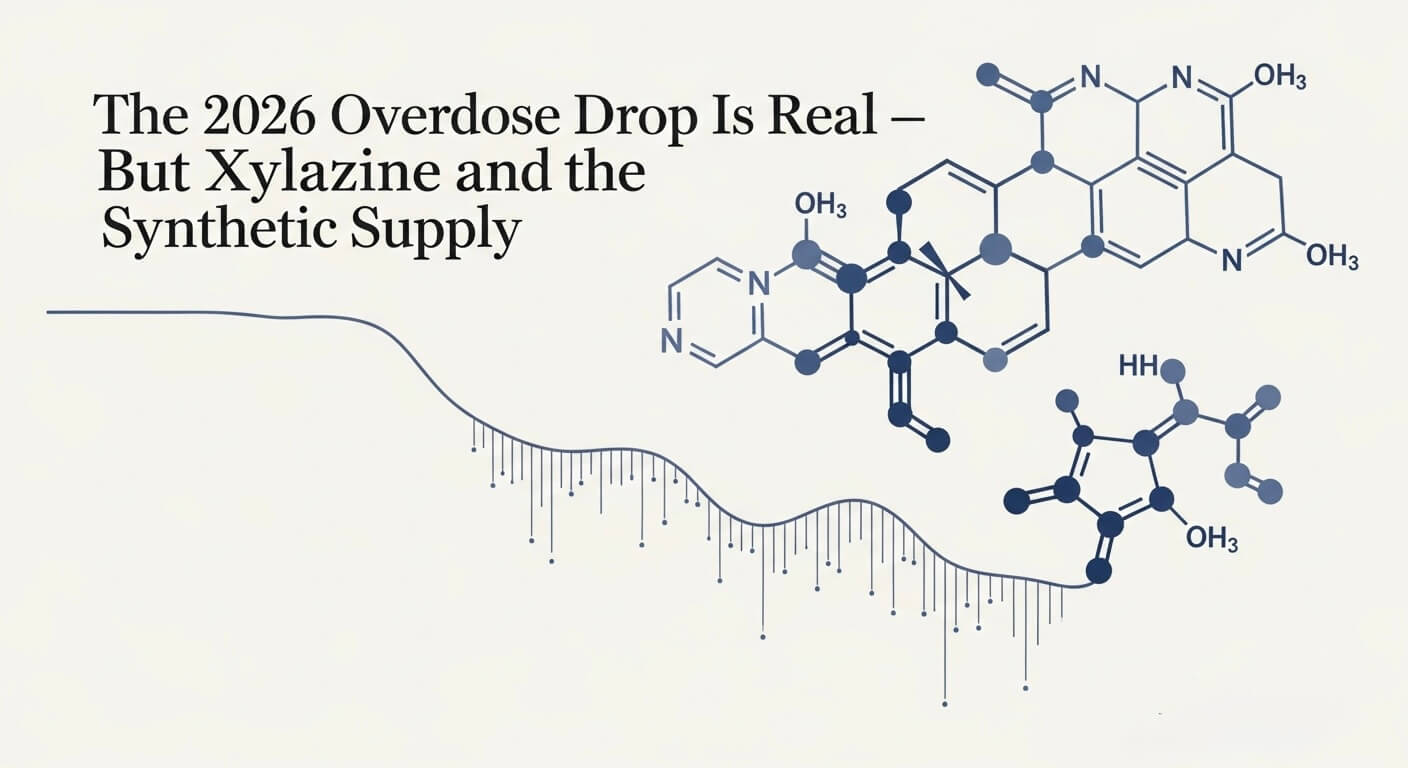
Overdose deaths fell 14% in 2025, but xylazine, medetomidine, and 23 newly identified synthetic opioids are reshaping what clinicians see in the exam room.
On May 13, 2026, the CDC’s National Center for Health Statistics published provisional data showing that overdose deaths in the United States fell roughly 14% in 2025, with an estimated 69,973 fatalities compared to 81,313 in 2024. It is the third consecutive year of decline, the steepest in more than a decade, and it is being driven primarily by reductions in deaths involving illicitly manufactured fentanyl. For clinicians who have spent the past several years bracing for the next bad number, this is genuinely good news.
But the headline obscures a more difficult clinical reality. The drug supply has not simply receded — it has continued to mutate. Xylazine, medetomidine, and a growing roster of novel synthetic opioids are reshaping addiction medicine. What overdose looks like in the exam room. What works in withdrawal management. What families need to ask of any treatment program in 2026. At Refresh Recovery, our clinical team is adapting protocols accordingly, and we want to share what we are watching, why it matters, and how dual-diagnosis outpatient care fits in.
What the May 13 CDC Release Actually Showed
The provisional 12-month numbers from the CDC’s National Vital Statistics System tell two stories at once. The national trend is unambiguously downward — overdose deaths are now at their lowest level since 2019, and synthetic-opioid-involved deaths (the fentanyl category) fell by roughly 18% year over year. Public health officials credit a combination of expanded naloxone access, growth in low-barrier buprenorphine prescribing, harm-reduction services, and meaningful disruptions to fentanyl precursor supply chains.
The second story is regional. Deaths in New Mexico, Arizona, and Colorado rose by more than 10% during the same period. Parts of the Pacific Northwest and Appalachia also showed flat or rising mortality. The DEA’s April 2026 advisory and a Cal/AG press release flagged the same mechanism. As the fentanyl supply tightens in some markets, traffickers adulterate product with veterinary sedatives and previously obscure synthetic opioids to stretch potency and yield. In the first five months of 2026, forensic chemists identified 23 new synthetic opioid analogues in seized material — more than were catalogued in all of 2024.
In other words: fewer people are dying, and the people who are still using are encountering a more chemically unpredictable supply than at any point in the crisis to date.
The New Synthetic Threat: Xylazine, Medetomidine, and Novel Opioids
The clinical challenge in 2026 is no longer simply fentanyl. It is the combination. Fentanyl mixed with one or more non-opioid sedatives that do not respond to naloxone and that produce withdrawal syndromes our standard MAT protocols were never designed to manage.
Why Xylazine Matters Clinically
Xylazine is a veterinary alpha-2 adrenergic agonist. On the street it is called “tranq.” It has been documented in the U.S. supply since the late 2010s. However, its prevalence has expanded sharply. It produces deep, prolonged sedation; it is not reversed by naloxone; and it is associated with a distinct pattern of severe, necrotic soft-tissue wounds that can occur at sites far from any injection. Patients presenting for treatment increasingly arrive with chronic wounds requiring coordinated wound care, infectious disease consultation, and, in some cases, surgical referral before standard SUD treatment can fully take hold.
The withdrawal syndrome is also distinct. Because xylazine acts on alpha-2 receptors rather than mu-opioid receptors, buprenorphine and methadone do not address the autonomic instability, anxiety, and dysphoria that xylazine-dependent patients experience when they stop using. Clinicians have begun layering adjuncts — clonidine, lofexidine, gabapentinoids, and, in inpatient settings, dexmedetomidine — to manage this component of withdrawal. ASAM has updated its clinical considerations accordingly, and the field is converging on a stabilization-then-induction approach rather than the single-protocol model that worked well for pure opioid use disorder.
Why Medetomidine Is Particularly Concerning
Medetomidine — a more potent veterinary cousin of xylazine — began appearing in the Northeast supply in 2024 and has since been detected nationally. An NPR report in April 2026 documented clusters of overdoses involving medetomidine in which responders administered standard or even repeated naloxone doses without restoring respiration, because the respiratory and central nervous system depression was driven by the alpha-2 component, not the opioid. Medetomidine withdrawal can also produce severe hypertension, tachycardia, and agitation that look more like sedative-hypnotic withdrawal than opioid withdrawal — a clinically meaningful difference that affects level-of-care decisions.
For families, the practical takeaway is this: naloxone remains essential and still saves lives in the majority of overdoses involving an opioid. But it is no longer sufficient on its own. Calling 911 — every time — has become more clinically important than ever, because rescue breathing and supportive care may be required even after naloxone has been administered.
Implications for Medication-Assisted Treatment
Programs that built their induction protocols around pure fentanyl exposure are now navigating patients whose tolerance, withdrawal profile, and physical health status reflect polysubstance synthetic exposure. Precipitated withdrawal risk during buprenorphine induction, already elevated with fentanyl, is further complicated when xylazine or medetomidine is on board. Many programs — Refresh Recovery included — have moved toward low-dose induction strategies, extended assessment windows, and more aggressive use of non-opioid adjuncts during the first 72 hours of stabilization. The literature on this is evolving quickly; recent JAMA commentary and ASAM practice updates are the best places to track changes.
What This Means for Dual-Diagnosis Outpatient Care
The population most affected by the synthetic supply is also the population most likely to be living with co-occurring mental health conditions. National data continue to show that roughly half of adults with a substance use disorder also meet criteria for a mental health disorder, with rates of PTSD, major depressive disorder, and anxiety disorders substantially higher than in the general population. The patients arriving at our intake assessments in 2026 are, on average, presenting with more complex trauma histories, more medical comorbidity, and more chemically diverse exposures than the patients we saw three years ago.
Treating substance use without treating the underlying mental health condition — or vice versa — is no longer a defensible clinical posture, if it ever was. Integrated care is not a marketing phrase; it is the standard of care endorsed by SAMHSA, ASAM, and APA practice guidelines. In practice, that means medication management, individual therapy, group therapy, family involvement, and psychiatric care delivered by a single coordinated team, with shared documentation and shared treatment planning. Refresh Recovery’s Joint Commission accreditation reflects this model. Our PHP, IOP, and outpatient programs are structured so that patients move through levels of care without losing their clinical team or starting over.
For patients with trauma histories — a majority of the people we serve — this continuity matters even more in 2026. Trauma-informed care is not a curriculum module; it is a way of organizing the entire treatment environment. When the drug supply is unpredictable and the medical complications are severe, predictability and relationship inside the treatment program become protective in a way that is hard to overstate.
What Patients and Families Should Ask Their Treatment Team in 2026
Whether you are evaluating Refresh Recovery or another program, a small number of questions will tell you a great deal about how seriously a clinical team has engaged with the current landscape:
- What is your naloxone protocol, and do you train family members? Programs should provide naloxone, train loved ones to use it, and explain explicitly that calling 911 is required even after a reversal — particularly given the prevalence of xylazine and medetomidine.
- How do you manage withdrawal from non-opioid contaminants? Look for specific mention of alpha-2 agonists (clonidine, lofexidine), wound care pathways, and coordination with primary care or infectious disease when needed.
- Is your program trauma-informed in practice, not just in language? Ask how staff are trained, how patient autonomy is preserved during induction, and how the program handles re-engagement after a return to use.
- How is mental health treatment integrated? A dual-diagnosis program should have psychiatric prescribers, licensed therapists, and SUD counselors operating from a single treatment plan — not three separate plans bolted together.
- What is your level-of-care continuum? The ability to move from PHP to IOP to outpatient within one organization reduces the most common point of relapse — the transition itself.
How Refresh Recovery Can Help
The 2026 overdose data is the first piece of good news this field has had in a long time. We do not minimize it, and we do not want anyone to read this and conclude that nothing is working — a great deal is working. At the same time, the patients in front of us are navigating a supply that is more pharmacologically diverse than it has ever been, and the clinical response has to evolve with it.
Refresh Recovery is a Joint Commission–accredited dual-diagnosis outpatient program serving adults with co-occurring substance use and mental health conditions. Our PHP, IOP, and outpatient levels of care are designed for continuity, and our clinical team includes psychiatric prescribers, licensed therapists, and addiction medicine clinicians working from a shared treatment plan. If you are a clinician considering a referral, or a family member trying to understand the right next step for someone you love, we would welcome the conversation. Contact our admissions team to discuss a confidential clinical assessment.
