
Nearly 60 Million Americans Live With a Mental Health Condition.
Last updated: April 2026
In general, most people hear “mental health” and think of anxiety or depression. But mental health is far more than a single experience. The CDC defines it as our emotional, psychological, and social well-being. Furthermore, it shapes how we think, feel, and act.
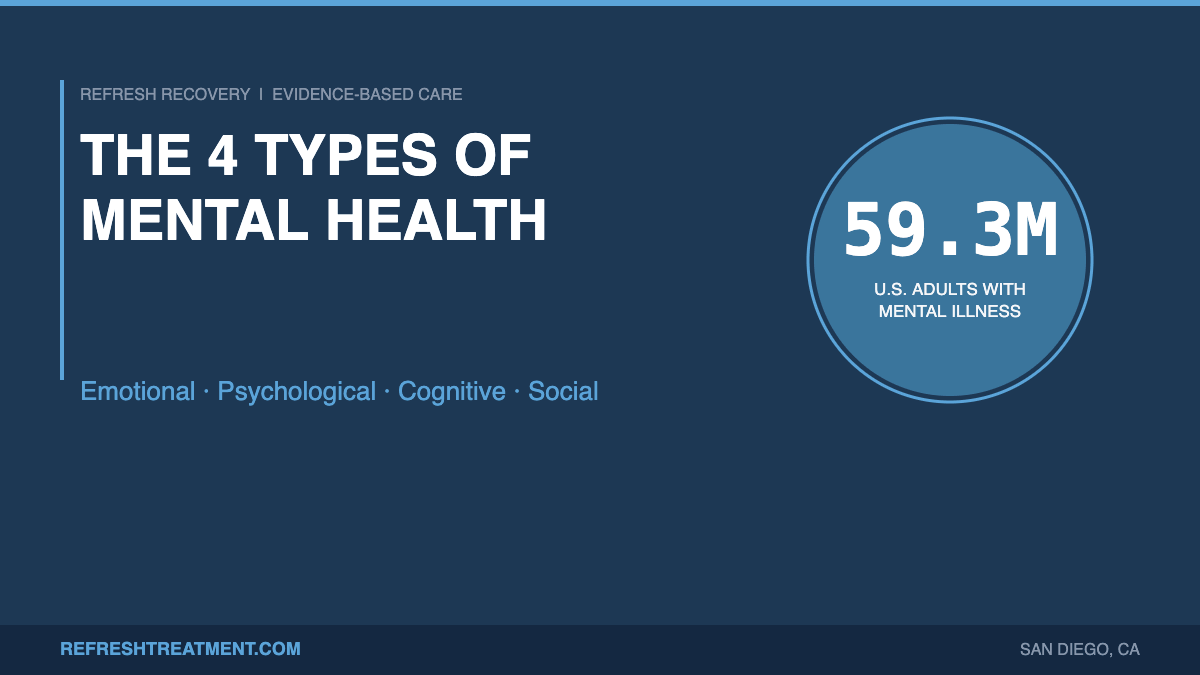
In fact, mental health operates across four dimensions. Specifically, these are emotional, psychological, cognitive, and social. In fact, understanding each one can change how you approach your own well-being.
At Refresh Recovery in San Diego, we see this every day. As a result, treating the whole person leads to lasting recovery.
1. Emotional Mental Health.
Emotional mental health is your capacity to recognize and express emotions. Furthermore, it is about regulating them in healthy ways. It determines how you respond to stress. It shapes how you cope with daily challenges.
Being happy all the time is not the goal. Instead, it is about experiencing the full range of human emotions. The goal is handling them without being overwhelmed.
For example, a person with strong emotional health can navigate grief and uncertainty. They do so without turning to substances or shutdown. At Refresh Recovery, we use CBT to build resilience. Clients learn to sit with discomfort.
Signs Your Emotional Health Needs Attention.
For instance, watch for persistent sadness lasting weeks. Difficulty naming what you feel. Reactions that feel out of proportion. Reliance on alcohol to cope. Or emotional flatness where nothing matters.
In reality, these experiences are common. SAMHSA reports 59.3 million U.S. adults experienced mental illness in 2024. Emotional distress is often the first warning sign.
2. Psychological Mental Health.
Essentially, psychological mental health involves your mind’s inner workings. Your self-perception, beliefs, and attitudes. The stories you tell yourself.
Consequently, it shapes how you handle adversity. Moreover, it forms your self-concept. Ultimately, it gives you purpose and agency.
Unfortunately, when it deteriorates, the effects are invisible. Loss of meaning. Chronic indecisiveness. Feelings of worthlessness. However, these are not character flaws. Rather, they are symptoms.
The WHO defines good mental health as realizing your abilities. It means coping with normal stresses. Working productively. Contributing to your community.
At Refresh Recovery, therapists use CBT and DBT. These modalities restructure harmful thought patterns. The goal is self-awareness over self-destruction.
3. Cognitive Mental Health.
Cognitive mental health is about executive functions. Processing information. Focusing attention. Retaining memories. Making decisions.
For example, brain fog during stress is a sign. So is poor focus after a bad night. These signal cognitive strain.
Additionally, cognitive challenges appear alongside depression, anxiety, PTSD, and substance use. This is especially true with prolonged use.
Importantly, for people in recovery, cognitive impairment is both symptom and barrier. Refresh Recovery includes cognitive rehabilitation in our programs. Effective treatment addresses how you think, not just how you feel.
4. Social Mental Health.
Similarly, social mental health is about connection and belonging. It reflects your ability to communicate and set boundaries. It means feeling part of a community.
We are social beings. Social connections are among the strongest predictors of well-being.
Healthy social functioning means trusting others. Resolving conflicts. Asking for help. Contributing to your communities.
On the other hand, when social health suffers, consequences ripple. Withdrawal from loved ones. Many people also struggle with social anxiety that deepens this cycle. Difficulty keeping a job. Increased substance use. Deepening isolation.
In particular, for people in recovery, social health is often the first casualty. Rebuilding it is critical. Group therapy and peer support are central at Refresh Recovery. Healing does not happen alone.
These Four Types Are Deeply Connected.
In other words, they do not exist in silos. They influence each other constantly. Emotional problems impair cognition. Social isolation weakens resilience. Cognitive decline blocks emotional processing.
Therefore, that is why dual diagnosis treatment works. Treating mental health and substance use together produces far better outcomes.
Start Your Recovery Today.
Above all, understanding these four types is practical and personal. If you recognize yourself here, you are not broken. You are becoming aware. That awareness is the first step. If you are unsure whether it is time to seek support, learn how to know if you need to start therapy.
As a result, our programs treat all four types. PHP, IOP, and Outpatient care. We are Joint Commission accredited and evidence-based.
Are you or someone you love struggling? Refresh Recovery is here. Reach out today. Your mental health matters.
