

Mental Health Is More Than the Absence of Illness. Here Is What It Really Means.
Last updated: May 2026
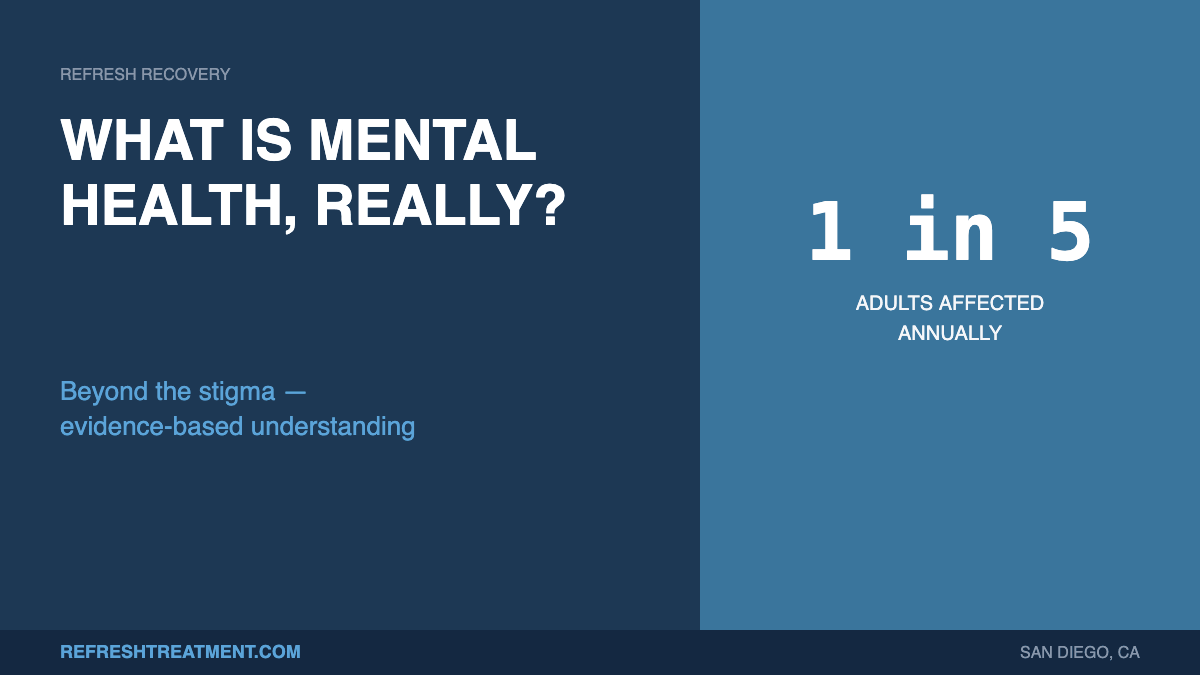
Ask ten people to define mental health. You will likely get ten different answers. Some describe it as not having anxiety or depression. Others equate it with happiness or emotional stability.
However, the clinical definition is far more nuanced. Understanding it can change how you approach your own well-being. To explore this further, read about how mental health affects us every day.
According to the World Health Organization (WHO), mental health is a state of well-being. Specifically, it enables people to cope with stress, realize their abilities, and contribute to their community. Notice what is missing from that definition. There is no mention of diagnosis, disorder, or illness. That is intentional.
The Centers for Disease Control and Prevention (CDC) expands on this. They describe mental health as emotional, psychological, and social well-being — what experts call the four types of mental health. It affects how we think, feel, and act. Furthermore, it influences how we handle stress, relate to others, and make choices.
In other words, mental health is not just the absence of problems. It is the presence of something positive. It includes resilience, purpose, connection, and the ability to function well.
Why the Definition Matters More Than You Think
Here is why this distinction matters. If you define mental health only as “not being sick,” you miss an entire spectrum. You can be free of any diagnosable condition and still struggle. Perhaps you feel disconnected or purposeless. Maybe you go through the motions without fulfillment.
Conversely, people living with diagnosed conditions can have strong mental health. Someone managing depression with treatment can still build meaningful relationships. They can pursue goals and experience well-being. The diagnosis does not define the person.
This matters for treatment too. A narrow definition leads to narrow interventions. A broader definition opens the door to holistic care. Instead of just reducing symptoms, we can build strength across multiple dimensions.
The Three Pillars of Mental Health
Both the WHO and the CDC frame mental health around three core dimensions. Each one plays a distinct role. Together, they create a complete picture of well-being.
Emotional Well-Being
Emotional well-being is about recognizing and managing your feelings. It means experiencing positive emotions regularly. Coping with difficult ones without becoming overwhelmed is equally important.
Strong emotional health does not mean constant happiness. Instead, it means being able to process grief, frustration, and anxiety without turning to harmful coping mechanisms. For people with substance use disorders (learn more about the basic definition of addiction), emotional regulation is often the first skill that needs rebuilding.
Psychological Well-Being
Psychological well-being includes your sense of purpose and self-acceptance. It also covers personal growth and autonomy. Do you feel your life has meaning? Can you make decisions aligned with your values? Do you have a stable sense of identity?
When psychological well-being declines, the signs are often internal. Chronic self-doubt appears. Motivation fades. You may feel trapped in patterns you cannot break. Additionally, identity confusion can make recovery feel impossible.
Social Well-Being
Social well-being reflects the quality of your relationships. It includes your sense of belonging within a community. Can you form meaningful connections? Do you trust others appropriately? Do you feel that your social world makes sense?
When social well-being declines, isolation increases. SAMHSA data consistently shows that social isolation is one of the strongest risk factors for both mental illness and substance use. As a result, rebuilding social health is a core part of effective treatment.
Mental Health Exists on a Spectrum
One of the most important shifts in modern psychology is the spectrum model. Mental health is not binary. You are not simply “well” or “unwell.” Instead, everyone exists on a continuum that shifts over time.
On one end, you find flourishing. People here have high emotional, psychological, and social well-being. On the other end, you find severe impairment. Most people fall somewhere in between.
Moreover, your position on this spectrum is not fixed. Stress, trauma, life transitions, and substance use can all shift it. So can therapy, community, healthy habits, and treatment. The goal is not perfection. It is consistent movement toward greater well-being.
This is why early intervention matters. You do not need a diagnosis to benefit from support. If your well-being is declining, that alone is reason enough to seek help.
How This Definition Shapes Treatment at Refresh Recovery
At Refresh Recovery in San Diego, this definition is the foundation of our clinical approach.
Our Partial Hospitalization Program (PHP) and Intensive Outpatient Program (IOP) do not just target symptoms. Instead, they build well-being across all three dimensions.
This includes individual therapy using CBT, DBT, and trauma-informed modalities. Group counseling rebuilds social connection.
Furthermore, we offer skills training in emotional regulation and mindfulness. Our outpatient programming supports consistent growth over time.
For individuals with dual diagnosis, this approach is especially critical. SAMHSA reports that 21.5 million adults had co-occurring mental illness and substance use disorder in 2024. Treating one without the other leads to relapse. Treating both together builds a foundation for lasting recovery.
What This Means for You
If you have been defining mental health as the absence of illness, consider a broader view. Ask yourself these questions. Do I feel emotionally resilient? Do I have a sense of purpose? Am I connected to people who matter to me?
If the answer to any of those is “not really,” you are not failing. You are identifying an area where growth is possible. That awareness is powerful.
In fact, understanding the 5 signs of mental illness can help you or someone you love take that first step. If you are unsure whether it is time to seek professional support, learn how to know if you need to start therapy.
At Refresh Recovery, we treat the whole person. We address the emotional, psychological, and social dimensions with compassion and clinical expertise.
Ready to take the next step? Contact Refresh Recovery today or call (858) 769-2773.
Parents and caregivers often ask how to support a child’s mental health alongside their own. For a practical companion read, see how to protect the mental health of our children — small daily habits that shape lifelong resilience.
